

Stop Asking Questions
Next time you're trying to make conversation, try making a statement instead


ME, BUT BETTER, my book about personality change, is out now. If you haven’t yet, please pick up your copy today. And if you’ve read the book, it would mean the world to me if you could leave an Amazon review. Thank you!
To win friends and influence people, Dale Carnegie wrote in 1936, you should, “Ask questions that the other person will enjoy answering. Encourage them to talk about themselves and their accomplishments.”
Ever since, “ask the other person questions” has been the go-to advice for making conversation. If you want someone to like you, the thinking goes, just ask them a bunch of questions. Women frustrated with self-centered men on dates implore them to “ask me a fucking question.” Much of the dating coaching on Love on the Spectrum involves reminding the participants to ask their date questions rather than to hold forth about llamas or whatever. Etsy brims with “wedding conversation starter” cards for people who get too wasted on the signature cocktail to think of any questions for their table-mates. The philosophy here is that people like to talk about themselves, so the more opportunities you give them to do that, the better.
This advice isn’t wrong, per se. When trying to get to know people, you should probably ask them some questions. But like that other Carnegie advice—to use the other person’s name early and often—this can become creepy and annoying if overused.
In fact, as I learned reporting my book, a far more effective strategy when getting to know strangers is to make statements.
I actually learned this from Georgie Nightingall, who led a conversation workshop I attended in the U.K. as part of my book research. One thing Georgie tried to show us in several of the exercises she led is that asking someone a bunch of rapid-fire factual questions—How was your flight? What do you do for work? Where did you go on vacation?—can sometimes lead to a conversational dead end. The situation can start to feel like a job interview, which is something I noticed when I was going on lots of platonic Bumble friend dates. Because I’m a reporter, I’d find myself switching into journalist mode when talking to my “date.” I would quickly get a layout of where she lived, what she did for work, and what she liked to do for fun, then instantly forget it all and leave without a sense of whether I actually wanted to be friends with her or not. I was gathering details about her life, but I wasn’t actually learning anything about her.
As Kate Murphy writes in You’re Not Listening, peppering people with questions like “What do you do for a living” or “Are you married” can feel like an interrogation. It can make people feel a little defensive and “shift the conversation into a superficial and less-than-illuminating resume recitation or self-promoting elevator pitch.”
Instead, what Georgie and some others recommend instead is to make a statement about yourself, the situation, or (delicately) the other person. Sometimes it’s easier to break the ice if you volunteer something first, even if it’s something kind of banal. When I was taking my son to a swim class that was my only opportunity for social interaction for the week, I found it went a lot better if I approached the other parents and said something like, “the water’s cold today!” or “what a cutie!” (about their baby). Sometimes people are just waiting on a little shred of information to hang their next question or statement on.
In fact, making statements is one of the core tenets of improv, which for decades has been helping awkward people become slightly less awkward. When I first started taking improv classes, I would try to get out of doing anything in the scene by just asking my scene partners a bunch of questions: Who are you? What are you doing here? and so forth. But my improv teacher quickly and wisely told me to quit doing this, because I was making everyone else do all the work. The other people don’t know who they are or what they’re doing here! It was my job to move the scene forward so we could all find out. The only way to do that was by making a statement about who I am, and what I’m doing here, so that my fellow improvisers had something to play off of.
Conversation is kind of like that. Few people want to go to a wedding or to a party so that they can explain the basics of their job to someone they’ll never see again. Few people enjoy reciting where they’re from, where they went to college, and how long they’ve known a couple. It’s generally more fun to react to something someone else is saying than it is to be in a low-level grilling session for hours.
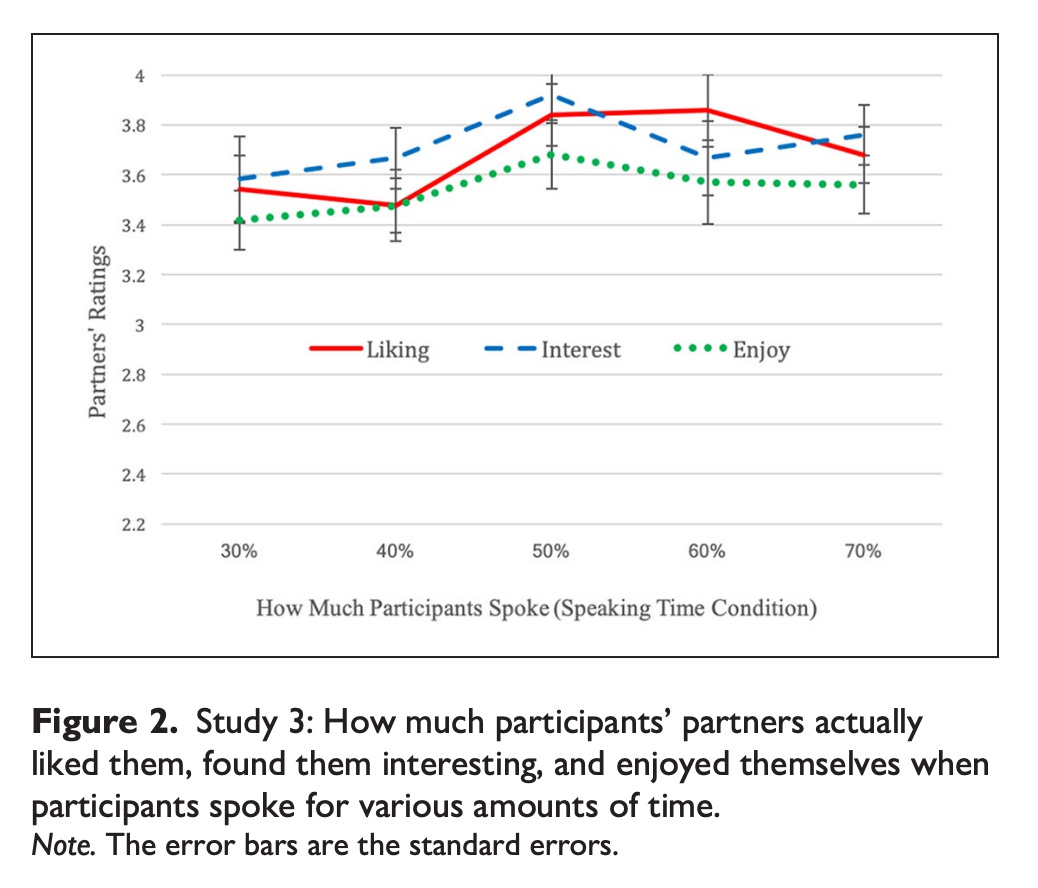
And good news: Research suggests people won’t actually like you less if you talk more rather than ask questions. For a study that came out a few years ago, researchers had study participants speak for 30%, 40%, 50%, 60%, or 70% of the time in a conversation. Contrary to what people predicted, their conversation partner liked them more when they spoke more. The conversation partners enjoyed the conversation more when the participant spoke half the time than when they spoke 30% of the time, and they found the more loquacious participants more likable and interesting, too. (The benefits seemed to plateau out a bit after they spoke 60% of the time, though, so apply this in moderation.)
Of course, this doesn’t mean you should try to dominate conversations or avoid asking any questions. No one is suggesting veering from Carnegie-land to the other extreme. But all these findings and experiences taken together have made me think of conversation as kind of like a gift. When you offer someone a statement about yourself, an observation about the environment, or a vulnerable admission, you’re making a bid for connection. You’re giving them something to work with. You’re asking the other person to share something about themselves, too, without outright saying it. It shows that you’re not gathering facts for some sort of appraisal or mental pop quiz. You’re showing that you’re on the same level as them, and that you just want to talk.
Love this and totally agree. I too liked “You’re not Listening” (great as audiobook). I often like to offer up some softball details about myself to get the ball rolling. I find it completely draining when people take the Carnegie approach and only ask questions, often to the point of deflecting questions about themselves and returning a question with a question. You end up not being able to learn anything about them, thus never finding common ground and never getting the conversation into a flow. And you can tell both people feel that lack of flow. Can’t wait to read your book!
Conversational doorknobs! https://www.experimental-history.com/p/good-conversations-have-lots-of-doorknobs